

What if your organization’s greatest contribution to society remains invisible because you’re measuring it with outdated tools?
The practice of evaluating community effects began in the 1970s. It grew from the environmental foundations of the 1969 U.S. National Environmental Policy Act.
This field has matured far beyond simple compliance. Today, it is a sophisticated discipline focused on human experience and well-being.
Traditional, static reporting often misses real-time shifts in community dynamics. We help you move beyond these limitations.
Our approach grounds every project in rigorous evidence. This satisfies both internal boards and external funding partners.
By 2026, leading organizations will treat societal effect as a continuous intelligence stream. They leverage AI-native platforms for actionable insights throughout a project’s life.
We believe a professional strategy for community benefit is the cornerstone of sustainable growth. It allows you to measure your true footprint on society effectively.
Key Takeaways
- The field evolved from 1970s environmental compliance to a discipline measuring human experience.
- Static reports fail to capture real-time community changes and dynamics.
- Rigorous evidence is essential for satisfying both internal boards and funding partners.
- Modern technology transforms evaluation into dynamic systems with actionable insights.
- A professional strategy for societal benefit is key to sustainable growth.
- By 2026, successful organizations will treat community effect as continuous intelligence.
- Moving beyond periodic compliance exercises unlocks true value and visibility.
Introduction to Social Impact Assessment
Moving beyond profit, contemporary leaders recognize that their work’s most significant outcomes are human. This understanding forms the bedrock of any serious evaluation of community consequences.
Defining Social Impact and Its Importance
Social impact refers to the profound changes an initiative creates for society. These effects extend far beyond economic metrics.
As Frank Vanclay outlined in 2003, categorizing these diverse effects is crucial. It helps us evaluate the true dimensions of change within communities.
We believe this understanding is fundamental. It shifts focus from simple outputs to lasting, meaningful transformation.
Historical Evolution and Modern Relevance
The field’s roots trace back to the 1969 National Environmental Policy Act (NEPA). This legislation initially mandated environmental reviews.
By the 1970s, the focus expanded to address social justice for local populations. Modern practice now demands a delicate balance.
Successful project delivery must align with a measurable focus on long-term community well-being. A robust process captures the human experience in a provable, evidence-based manner.
We help you design frameworks that integrate these historical lessons. The goal is to foster positive socio-economic change for all stakeholders.
Understanding How to Conduct Social Impact Assessment
The most critical phase of any community-focused initiative begins long before ground is broken. This foundational work defines your purpose and maps the human landscape your project will affect.
Clarifying Objectives and Stakeholder Needs
First, you must crystallize your core objectives. Are you evaluating long-term community benefits or ensuring environmental justice? Clear goals provide a definitive roadmap for your entire evaluation.
Engaging stakeholders early is not optional; it is the most critical part of the process. The 2003 Ghana underground water project stands as a cautionary example. Its failure was directly tied to poor engagement and overlooked community concerns.
We guide you in identifying the specific social dimensions to address. These often involve health, local employment, potential displacement, or cultural heritage preservation. Defining clear geographic and temporal boundaries is equally vital.
Our methodology ensures project goals align with the needs of local populations, government bodies, and NGOs from the first planning stage. This strategic alignment prevents the common pitfalls of misaligned expectations and budget overruns.
The Importance of Data Collection and Quality in Impact Assessment
Your ability to demonstrate real-world change hinges on a single, critical factor: the quality of your information. Flawed data collection undermines the entire narrative of your program’s success.
We build systems that ensure your evidence is consistent, representative, and systematic. This reliable foundation is non-negotiable for credible analysis.
Utilizing Unique Participant IDs for Longitudinal Tracking
Effective strategy requires tracking individual journeys over time. Assigning unique participant IDs from day one enables this longitudinal view.
You can see how a single person interacts with multiple program touchpoints. This depth transforms scattered data points into a coherent story of progress.
Ensuring Integrated Data Streams
Traditional methods fail by siloing numbers and narratives. Our integrated data streams process qualitative feedback and quantitative metrics together.
We advocate for validation rules that prevent quality problems at the point of entry. By 2026, AI-native platforms will make every data point analysis-ready from the moment it enters the system.
This forward-looking approach eliminates months of manual cleanup. It provides real-time visibility into performance, forming a powerful evidence pipeline for all your social impact analysis.
Overcoming Traditional Social Impact Challenges
Many well-intentioned initiatives falter not from a lack of vision, but from relying on fragmented systems that cannot capture real human progress. A common pitfall is treating the entire evaluation as a mere formality. This approach divorces it from strategic design and continuous improvement.
Superficial stakeholder engagement remains a major roadblock. When community voices, especially from marginalized groups, are an afterthought, the entire process loses its validity. Pressure to reduce costs or accelerate timelines often forces rushed work. This undermines long-term success.
The 2003 Ghana water project exemplifies this failure. Material shortages and budget overruns were direct results of poor early engagement. We help you navigate these pressures by building strategic alignment from the start. Our focus ensures monitoring systems account for gradual, long-term community dynamics.
We eliminate the architectural problems that cause traditional methods to break down. By replacing fragmented, manual workflows with continuous intelligence, we transform a static compliance exercise into a dynamic engine for positive change.
Transitioning from Annual Reports to Continuous Stakeholder Intelligence
The era of waiting a full year to understand your program’s effect on communities is officially over. Static reports cannot capture the dynamic nature of real human progress. We facilitate a fundamental shift towards continuous stakeholder intelligence.
This move allows you to adapt initiatives while they are still active. Platforms like Sopact Sense create a single evidence pipeline. Data quality is enforced at collection, and insights reach decision-makers in real time.
Real-Time Dashboards and AI-Driven Insights
Our real-time dashboards provide your board and funders with strategic KPIs and clear trend lines. This ensures constant transparency and builds lasting accountability. You move beyond mere compliance exercises.
AI-driven insights process hundreds of narrative responses in minutes. They extract hidden themes and community sentiment from vast qualitative data. This power transforms manual document review into instant, actionable understanding.
We help implement AI-powered evidence pipelines that connect every stakeholder response to a participant identity. This creates a robust, longitudinal record for your social impact analysis. The shift is architectural, ensuring genuine data-informed learning replaces accountability theater.
Selecting the Right Social Impact Assessment Framework
Selecting a methodology is less about picking a label and more about building a functional engine for change. The right structure turns your vision into a measurable, actionable plan.
Theory of Change and Causal Pathway Mapping
We use Theory of Change as our foundational method. It maps the causal pathway from your initial inputs to the desired long-term community benefit.
This process makes your core assumptions explicit and testable. It creates a clear blueprint for your entire evaluation strategy.
Exploring IRIS+, SDGs, B4SI, and 2X Global
Different standards serve distinct purposes. IRIS+ provides a library of standardized metrics for investors.
The 17 Sustainable Development Goals (SDGs) offer a universal language for global development relevance. For corporate teams, the B4SI framework standardizes the measurement of community investment.
2X Global defines specific thresholds for initiatives focused on gender equity. Success hinges on operationalizing your chosen framework rapidly.
Our platform is framework-agnostic. It lets you combine standards like SDGs and IRIS+ into one cohesive data process.
We translate your selected structure into working surveys and validated rubrics. This provides the actionable evidence needed for your specific goals.
Designing Clean Data Collection Processes
The integrity of your entire evaluation rests on the systems you build to gather information from the very start. Failures in this initial design phase lead directly to months of manual cleanup. This inefficiency drains your project budget and delays vital insights.
Establishing Validation Rules and Unique IDs
We help you assign unique participant IDs from the first interaction. This allows for seamless longitudinal tracking across all program touchpoints. You gain a complete view of individual journeys without manual data matching.
Building validation rules directly into your surveys is essential. These rules prevent empty submissions and standardize formats for dates and responses. Every piece of information becomes analysis-ready at the point of entry.
Our methodology captures qualitative narratives and quantitative metrics within the same instrument. This integration prevents disconnected data streams. We also recommend deploying always-on feedback links for continuous input.
This rigorous design ensures your data remains accurate and truly representative. It creates a solid foundation for all subsequent program evaluation and strategic decision-making.
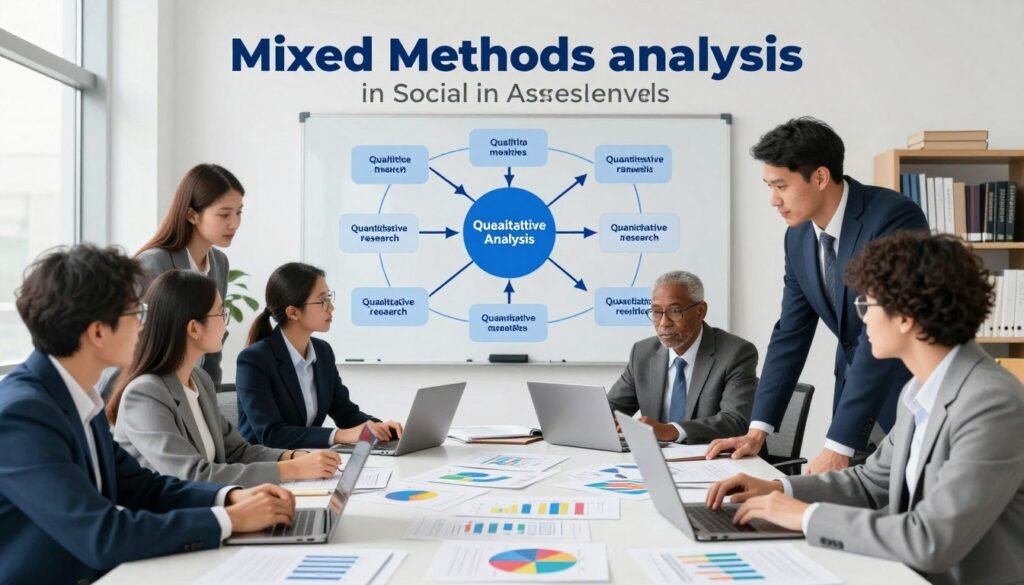
Conducting a Mixed Methods Analysis
Demonstrating value requires answering two fundamental questions: what changed, and why did that change occur?
Balancing Quantitative Metrics with Qualitative Narratives
We conduct analysis by triangulating statistics with stories. This explains both the measurable outcomes and the human reasons behind them.
Quantitative review examines changes against your baselines. Our AI tools simultaneously process hundreds of narrative responses to extract core themes and sentiment.
Integrating these data types produces evidence that is credible for boards and compelling for communities. You build a complete picture of your program’s effect.
AI-powered analysis uncovers patterns and correlations in minutes. It also disaggregates results by demographics, revealing nuanced insights across participant groups.
This comprehensive approach validates your hypotheses. It demonstrates the true value of your intervention with a high degree of statistical confidence.
Reporting, Deciding, and Adapting Based on Findings
A report that sits on a shelf represents a missed opportunity for genuine transformation. The final value of your evaluation emerges when insights drive real-time decisions and program adaptations.
Creating Audience-Specific Reports
We translate complex findings into formats that resonate with each stakeholder group. Funders receive strategic KPIs linking activities to long-term community benefits. Operational dashboards give managers real-time visibility for daily adjustments.
Acting on discoveries while initiatives are active is crucial. Our tools build direct feedback loops, connecting insights to immediate program modifications. This fosters a culture of continuous improvement and learning.
We ensure your reports demonstrate clear accountability. They transparently connect project actions to intended social outcomes. Accessible summaries shared with communities build trust and maintain transparency.
Ultimately, these tailored documents empower informed decisions. They optimize your strategy and maximize the value of every investment in positive change.
Leveraging AI and Advanced Tools in Social Impact Assessment
The right technology transforms a complex evaluation from a burden into a strategic advantage. Modern platforms redefine the entire evidence-gathering process.
AI-Powered Evidence Pipelines and Instant Analysis
We build intelligence systems that enforce data quality from the start. An AI-native architecture, like Sopact Sense, allows for side-by-side analysis of mixed-method evidence.
This creates a single, integrated platform. It replaces fragmented, manual workflows of the past.
Your team gains instant analysis and live dashboards. These provide a clear picture of program performance at any moment.
You move beyond legacy software designed for simple collection. Modern solutions manage complex, connected evidence at scale.
These tools free your team to focus on strategic decision-making. They eliminate months of manual data cleaning and coding.
We ensure your technology stack directly supports your mission. It delivers the precision needed for large, multi-country initiatives.
Real-World Applications and Case Examples
From massive infrastructure projects to local workforce initiatives, applied insights drive meaningful progress.
The Narmada Dam Project in India stands as a powerful illustration. Project leaders altered the dam’s design, lowering its height. This change minimized community displacement and preserved environmental integrity.
Such proactive adjustments demonstrate responsible development in action. They show that a rigorous evaluation can preserve social cohesion.
Consider youth workforce development programs serving 500 participants. Tracking skills acquisition and job placement rates is essential. This data reveals which training components deliver the best employment outcomes.
We help community health initiatives in rural clinics combine clinical data with survey responses. This measures maternal health outcomes and service accessibility effectively.
These applications prove that a professional social impact assessment is a practical tool. It moves beyond theory to deliver measurable community benefits.
By analyzing these case examples, we guide you in applying our methodology. This applies across engineering, construction, or social services sectors. Our approach ensures your interventions deliver value while mitigating risks.
Key Steps: A Step-by-Step How-To Guide
A structured approach transforms your evaluation from a theoretical exercise into a powerful engine for measurable community benefit. We outline five critical steps to build a robust evidence base.

Defining Scope, Data Collection, and Analysis
Begin by crystallizing your scope and Theory of Change. This initial step ensures every data point aligns with your core mission for social impact.
Next, design clean collection processes with unique participant IDs. Validation rules enforce quality from the start.
Gather information across all program touchpoints. This creates a longitudinal record of individual journeys.
Employ mixed methods analysis. Combine statistics with AI-extracted themes to explain both what changed and why.
Reporting, Decision-Making, and Adaptive Strategies
The final phase turns insights into action. Create audience-specific reports for funders and managers.
Use these findings to inform real-time program adjustments. This adaptive strategy maximizes your positive community effect.
Following this guide ensures your impact assessment is thorough and mission-aligned.
Conclusion
The true measure of your organization’s legacy lies in the sustained well-being of the communities you touch. A rigorous social impact assessment is essential for fostering positive, lasting change.
Moving from static reports to continuous stakeholder intelligence allows for data-informed decisions that improve lives. Implementing the steps outlined ensures your projects are both responsible and successful.
The shift to AI-native architecture overcomes historical fragmentation in these evaluations. Your commitment to measuring impact satisfies funders and builds trust with stakeholders.
We partner with you to catalyze this transformation. Together, we turn strategic goals into measurable, real-world results.
FAQ
Why is a social impact assessment so critical for our organization?
A rigorous assessment moves you beyond good intentions. It provides the evidence you need to prove your value, secure funding, and make smarter decisions. We help you measure what truly matters to your stakeholders and your mission.
What exactly do we mean by ‘social impact’?
Social impact refers to the significant, positive change your work creates for people and communities. This includes improvements in well-being, economic opportunity, health, and equity. It’s the real-world difference your programs make over time.
How does data quality affect our impact evaluation?
High-quality information is the foundation of credible reporting. Clean, validated data allows for accurate tracking of outcomes over time. We emphasize unique participant IDs and integrated data streams to ensure your insights are reliable and actionable.
What are common hurdles in traditional evaluation methods?
Many teams struggle with manual data entry, outdated annual reports, and disconnected information sources. These slow you down and create blind spots. Our approach modernizes this with continuous, streamlined processes that save time and increase accuracy.
Can we move beyond static annual reports?
Absolutely. We champion a shift to continuous stakeholder intelligence. This means using real-time dashboards and AI-driven insights to understand community needs as they evolve, allowing for faster, more responsive program adaptations.
Which measurement framework is right for our work?
The best framework aligns with your goals. We often guide clients through options like IRIS+ for impact investing, the UN Sustainable Development Goals (SDGs) for global alignment, or B4SI for corporate social investment. The choice depends on your audience and objectives.
What makes a data collection process ‘clean’?
A clean process minimizes errors from the start. It involves setting clear validation rules, using consistent unique identifiers for tracking, and ensuring all data streams—from surveys to financials—work together seamlessly.
Should we use numbers or stories in our analysis?
The most powerful approach uses both. Quantitative metrics show the scale and trend of your outcomes. Qualitative narratives from interviews or feedback explain the ‘why’ behind those numbers, providing rich context for your results.
How do we turn assessment findings into action?
We help you create audience-specific reports that drive decisions. Whether for board members, investors, or community partners, clear reporting highlights key insights and recommends adaptive strategies to enhance future program effectiveness.
How can advanced tools like AI help our team?
AI-powered evidence pipelines automate data analysis, surfacing instant insights from large datasets. This frees your team from manual work, allowing you to focus on strategic interpretation and deepening community engagement.
What are the essential steps to get started?
Begin by defining your scope and engaging stakeholders. Next, design a robust data collection plan, execute a mixed-methods analysis, and report findings clearly. Finally, use those insights for informed decision-making and adaptive strategy, creating a cycle of continuous improvement.
